
Passover Overview 2026
Read about the observances of Passover, as well as schedule and times
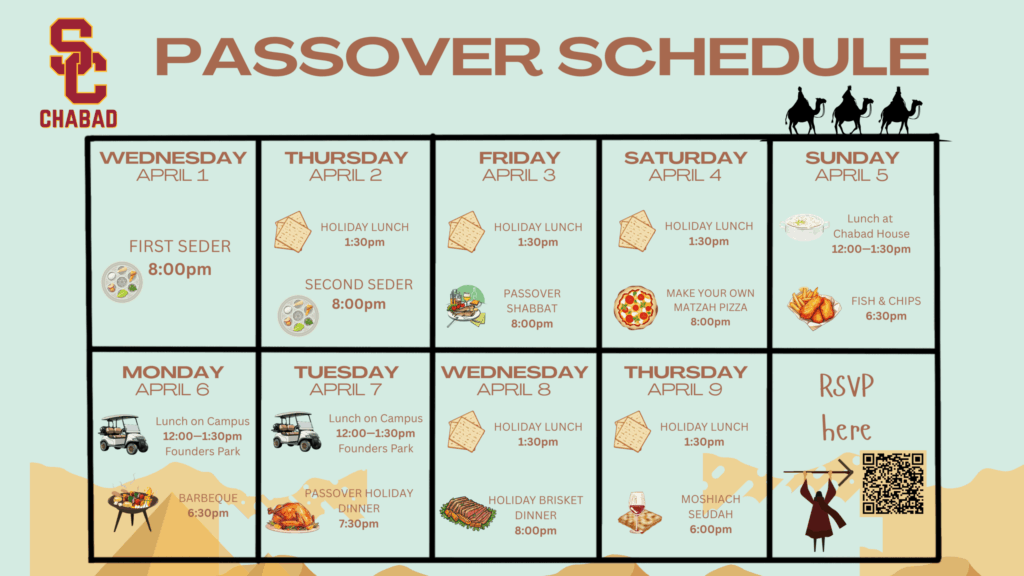
To RSVP for Seders and meals, click HERE.
Tuesday, March 31:
Check the house for Chametz in the evening, after nightfall (7:39 pm). Some customs call for hiding ten bits of bread (carefully wrapped to avoid crumbs) to ensure that there is something to find. Recite the Kol Chamira rendering any Chametz you may have missed ownerless.
Make sure you have filled out a Chametz sale form.
Chametz may continue to be eaten until Wednesday morning—however, all Chametz being kept on your property after Tuesday night should be in designated areas.
Wednesday, April 1 — Pesach Eve
Morning Minyan at 7:00 am. Special Siyum ceremony for firstborns after services, a last-chance Chametz breakfast, and burning of the Chametz.
Finish eating Chametz in mid-morning before 10:50 am.
Burn any leftover bits of chametz and recite the kol chamira by 11:54 am. (Your Chametz dishes, etc., must have been set aside and sold by this time.) If you’d like, you can bring your bread over for burning in the Chabad House backyard any time before 10:00 am.
Throughout the rest of the day, one may eat neither Chametz nor Matzah. Anything else may be eaten as normal (though some traditions avoid all the ingredients of the Seder plate, i.e. egg, charoset, lettuce, etc.).
Candle Lighting 18 minutes before sunset: 6:56pm
Services at Chabad House: 7:00 pm
Seder at 8:00 pm.
Wednesday, April 1 — First Seder Night
6:56pm Candle Lighting
7:00pm Services
8:00pm Pesach Seder 1
Thursday, April 2 — First Day of Passover
9:30am Morning Mysticism
10:30am Morning Services
1:30pm Lunch
after 7:52pm Candle Lighting
8:00pm Services
8:30pm Pesach Seder 2
Friday, April 3 — Second Day of Passover
9:30am Morning Mysticism
10:30am Morning Services
1:30pm Lunch
6:58pm Candle Lighting
7:00pm Services
8:00pm Passover Shabbat
Saturday, April 4 — Third Day of Passover
9:30am Morning Mysticism
10:30am Morning Services
1:30pm Lunch
8:00pm Matzah Pizza Night
Sunday, April 5 — Fourth Day of Passover
12:00pm Passover Lunch
6:30pm Passover Dinner – Fish & Chips
Monday, April 6 — Fifth Day of Passover
12:00pm Passover Lunch on Campus
6:30pm Pesach BBQ
Tuesday, April 7 — Sixth Day of Passover
12:00pm Passover Lunch on Campus
7:00pm Services
7:01pm Candle Lighting
8:00pm Dinner
Wednesday, April 8 — Seventh Day of Passover
9:30am Morning Mysticism
10:30am Morning Services
1:30pm Lunch
after 7:57pm Candle Lighting
8:00pm Services
8:30pm Dinner
Thursday, April 9 — Eighth Day of Passover
9:30am Morning Mysticism
10:30am Morning Services
1:30pm Lunch
6:00pm Moshiach Seudah
The Meaning of Passover
G-d promised Abraham the Land of Israel. However, G-d told him, “Your children will sojourn in a land that is not theirs, and they will be enslaved and persecuted for four hundred years. After that they will leave with great wealth. And also the nation whom they will serve I shall judge.”
Indeed, Jacob and his sons traveled down to Egypt, and were eventually enslaved by the Egyptians. In the year 2448 (1312 BCE), after a series of miraculous plagues and warnings, G-d had Moses lead the Jewish people out of slavery, towards receiving the Torah on Mount Sinai and from there to the Land of Israel.
A Quick Chronology:
10th of Nissan: G-d instructs the Jewish people through Moses that every person should prepare a sheep for the Paschal sacrifice, to be offered four days later.
14th of Nissan: Each Jewish home offered the Paschal sacrifice, and put some of its blood on their doorposts.
eve of 15th of Nissan at midnight: G-d smites the first born of every Egyptian family, sparing the Jewish houses identified by the sacrificial blood.
Immediately following: The Jewish people are rushed to leave Egypt immediately, that very night. There was no time even to allow the bread for the journey to rise, and so they took with them Matzah (unleavened bread).
7 days later (the 21st of Nissan): The Jewish people arrive at bank of the Sea of Reeds, newly chased by a once again angry Egyptian army. G-d split the sea, allowing the Jews to pass through in comfort. (They didn’t actually cross the Sea of Reeds, as they actually exited on the same side they had entered, though slightly further down the coast.) The Egyptians who had followed behind them weren’t so lucky: They were drowned in an angry sea.
The Jewish people recited the famous Az Yashir song, praising G-d for His deliverance.
In commemoration of these special events, we are commanded by the Torah to celebrate the holiday of Pesach. The first two days (in Israel, just the first) are regarded as Yom Tov (a holy day in which no work is done) as are the last two days, remembering the great miracles wrought to our forefathers on those dates.
Indeed, we do not just view these miracles as dead, long-ago history, but rather as an essential part of our day-to-day growth and process of redemption and liberation.
As with the other holidays, for the past two thousand years Jewish tradition has required of those in the Diaspora to celebrate two days rather than just one. Although this originally began as a result of the delays faced by the messengers of the court in Jerusalem, who were to tell them which date had been established as the New Month, it is also a reflection of the greater spiritual qualities possessed by the Holy Land of Israel: The spiritual awakening that can be accomplished in one day in Israel requires two days in the Diaspora. As a result, we celebrate the first two days of Pesach as holidays, and an eighth day in addition to the seventh.
During these eight days, we are prohibited to eat — or even to possess — any Chametz (leaven). Basically, that includes any mixture of flour with water except for the extremely strict conditions involved in the baking of Matzah — a process in which less than eighteen minutes elapse from when the water and flour first touch until after the Matzah is already fully baked. In order to avoid having to throw out all our regular pots and pans, etc., tradition calls for the sale of Chametz. In this transaction, we place all of our Chametz utensils, Chametz, and the like, in designated, closed-off areas (such as a cabinet which is taped shut or the like), and — through a competent Rabbi — sell it to a non-Jew for the duration of the holiday.
Form available here.
In addition, we have the special Mitzvah on the first and second nights of Pesach to eat Matzah, drink four cups of wine, eat Maror (bitter herbs), and relate the story of Passover (known as the Haggadah). This ceremony is known as the Seder.
